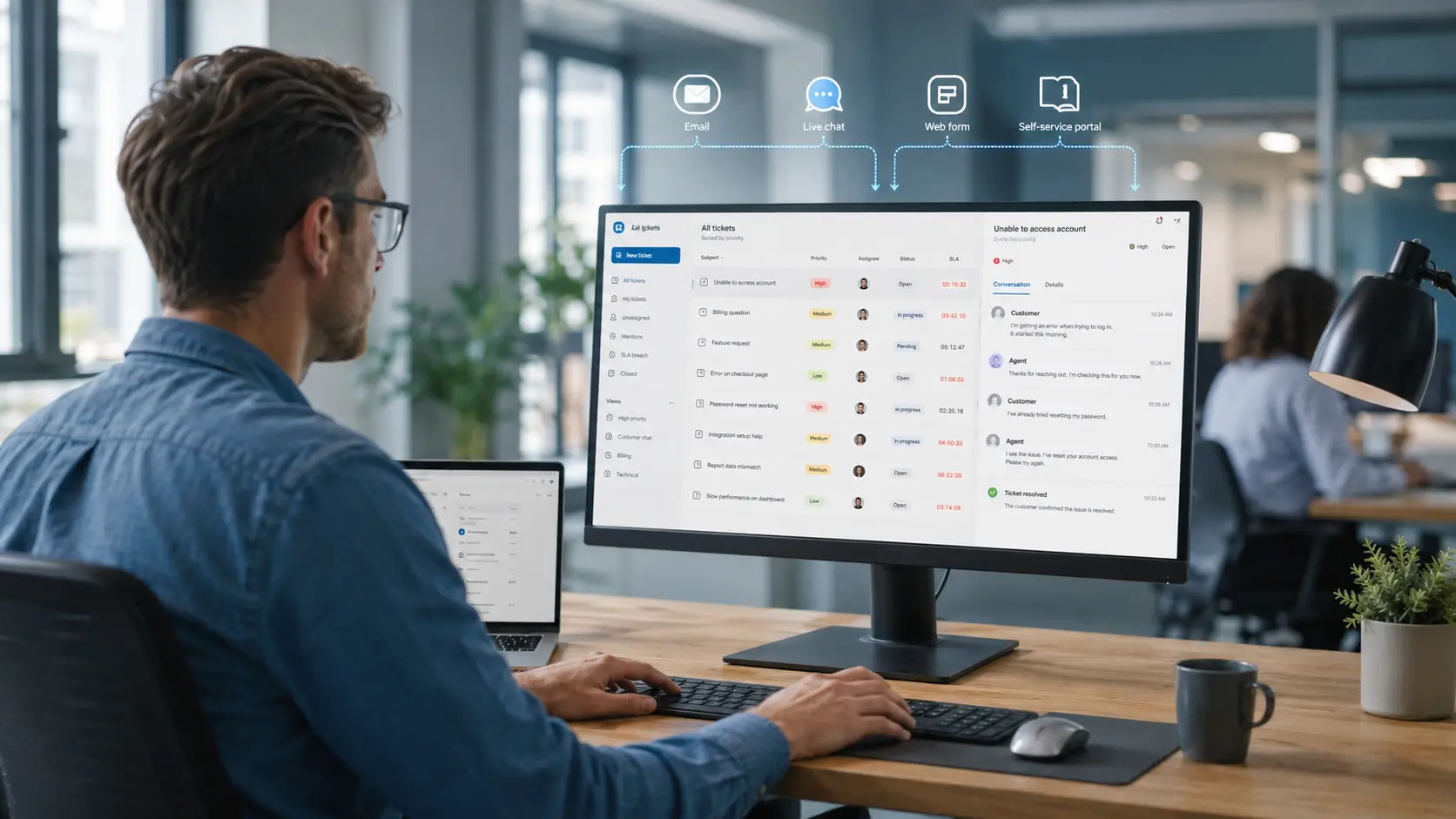

When IT works well, no one notices. When it breaks, everyone does. IT service management is the discipline that keeps technology services reliable, so the business can depend on them.
ITSM is more than fixing broken laptops. It is a structured way to design, deliver, and improve every IT service an organization provides.
This guide explains what ITSM is, its core processes, and how it relates to frameworks like ITIL. Each section links to a deeper article so you can go further on any topic.
IT service management, or ITSM, is how an organization manages the IT services it delivers to users. It covers the full lifecycle, from designing a service to supporting it day to day.
The key idea is treating IT as a set of services, not just technology. Email, network access, and application support are all services that users depend on.
ITSM brings structure to how those services are requested, delivered, and improved. It uses defined processes so outcomes are consistent rather than ad hoc.
The goal is reliable service and satisfied users. Done well, ITSM aligns IT work with what the business actually needs.
These terms overlap, which causes confusion. Separating them makes the picture clear.
A help desk is a support function focused on fixing issues and answering questions. It is often break-fix and user-facing.
A service desk is broader. It is the single point of contact for all IT services, handling incidents and service requests within an ITSM approach.
ITSM is the widest term. It is the overall practice, and the service desk is one part of delivering it.
In short, ITSM is the strategy, the service desk is the front door, and the help desk is the support that fixes problems.
“Service Desk vs Help Desk: What’s the Difference?”
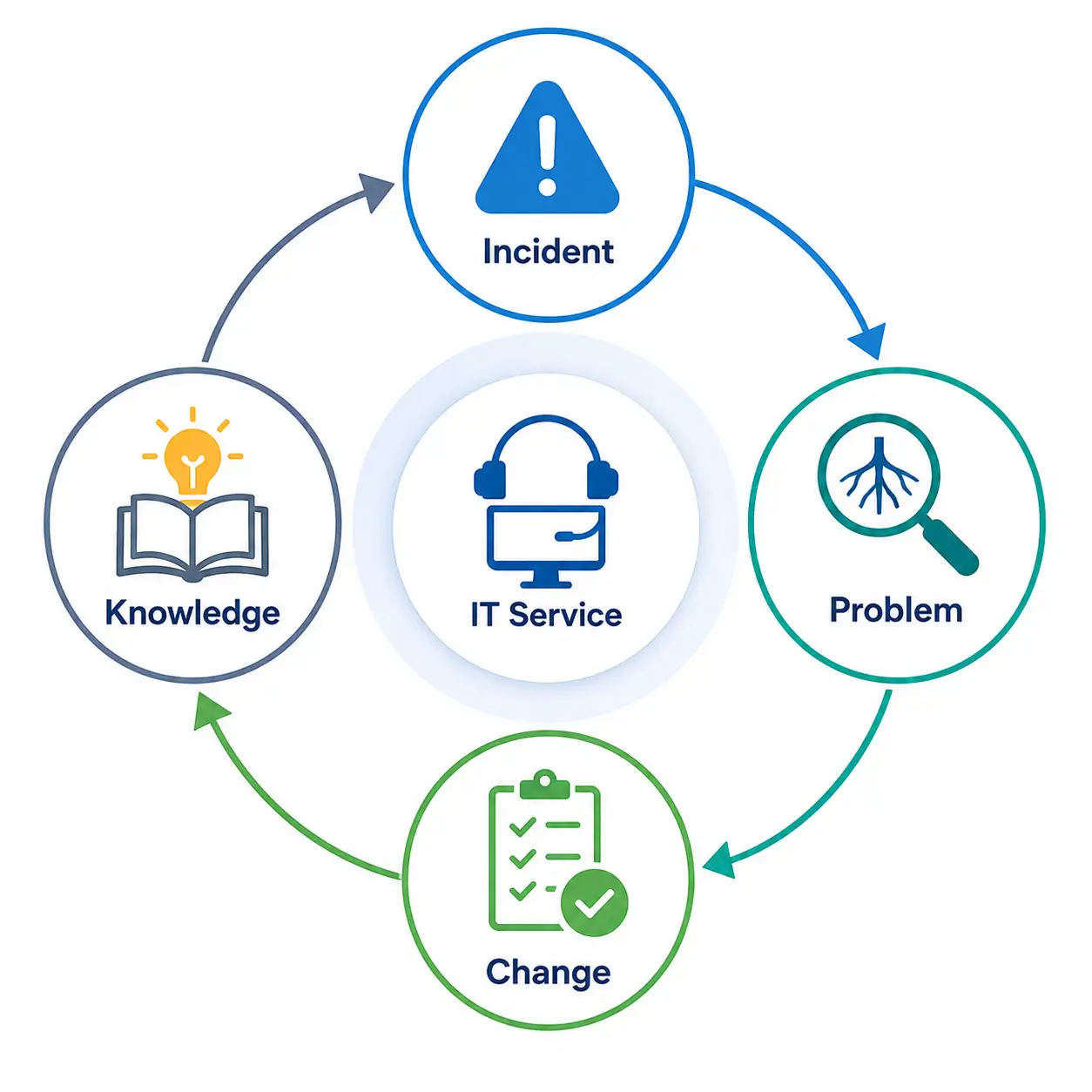
ITSM is built from a set of connected processes. Each one handles a different kind of work, and together they keep services running.
An incident is any unplanned disruption to a service, like an outage or an error. Incident management restores normal service as quickly as possible.
The priority here is speed. The aim is to reduce downtime and get users working again.
“Incident Management: A Complete Guide.”
A service request is a routine ask, such as new software or access. It is planned, not a disruption.
Service request management handles these efficiently, often with standard workflows and approvals. It keeps everyday requests from clogging the queue.
A problem is the underlying cause of one or more incidents. Problem management finds and fixes that root cause.
Where incident management restores service fast, problem management stops the issue from recurring. The two work hand in hand.
“Problem Management Explained.”
Change management controls how changes to IT services are made. It reviews, approves, and schedules changes to reduce risk.
The aim is to make changes without causing new incidents. A careful process protects stability while still allowing progress.
“Change Management in ITSM: Types, Process & Best Practices.”
This process tracks IT assets and how they connect. It answers what you have and how the pieces depend on each other.
Good asset and configuration data supports every other process. It makes incidents faster to diagnose and changes safer to plan.
Knowledge management captures solutions and guidance in a shared library. It lets teams and users reuse answers instead of solving the same issue twice.
A strong knowledge base speeds resolution and powers self-service. It is the memory of the service desk.
Frameworks give ITSM a common language and proven practices. You do not have to invent your process from scratch.
ITIL is the most widely used framework. It offers a set of best practices for delivering IT services, and its terms are used across the industry.
Other approaches exist too. COBIT focuses on governance, while frameworks like DevOps and Agile influence how modern IT teams work.
You do not need to adopt a framework wholesale. Many teams take the practices that fit and leave the rest.
“What Is ITIL? A Beginner’s Guide.”
Structured service management pays off in several ways. Each benefit ties to a real business need.
Reliability improves first. Defined processes mean incidents are resolved faster and changes cause fewer surprises.
Efficiency follows. Automation and standard workflows remove repetitive manual work, so the team handles more with the same effort.
Visibility is another gain. Tracking every request and incident gives managers the data to spot trends and improve.
Finally, user satisfaction rises. When services are dependable and requests are handled quickly, trust in IT grows.
You cannot improve what you do not measure. A few metrics show whether your services are actually getting better.
Mean time to resolve (MTTR) tracks how long incidents take to fix. A falling MTTR means faster recovery and less downtime.
First response time shows how quickly the service desk acknowledges a request. A fast first response reassures users that their issue is being handled.
SLA compliance measures how often you meet your agreed targets. It is the headline number for reliability.
Other useful metrics include ticket volume, reopen rate, and customer satisfaction (CSAT). Together they reveal both efficiency and quality.

The same ITSM approach works outside IT. When other departments adopt it, the practice is often called enterprise service management, or ESM.
HR, facilities, and finance all field requests that look a lot like IT tickets. Onboarding, repairs, and reimbursements can run on the same service desk model.
Using one platform for all of them reduces tool sprawl. It also gives leadership a single view of service across the whole organization.
This is why a modern service desk is not only for IT. The structure that keeps IT reliable can keep every internal team responsive.
“One Helpdesk for IT, HR & Facilities Requests.”
Adopting ITSM works best in stages. Trying to do everything at once usually stalls.
Treat this as a journey. Each step builds on the last and delivers value on its own.
The right tool makes ITSM practical rather than theoretical. A few capabilities matter most.
Match the tool to your maturity. Start with what you need now, and choose a platform that can grow with you.
ITSM is a team effort, and clear roles keep it running. A few core roles appear in most organizations.
Service desk agents are the front line. They log incidents and requests, resolve what they can, and route the rest.
Process owners are accountable for a specific practice, such as incident or change management. They define how the process works and keep it improving.
Technical specialists handle complex issues that the front line escalates. They bring deep expertise for tricky incidents and problems.
Finally, a service owner is responsible for a whole service end to end. They make sure it meets user needs and business goals.
Smaller teams often combine these roles. One person may run the service desk and own several processes at once.
ITSM efforts fail in predictable ways. Knowing them helps you sidestep the usual traps.
The first is over-engineering the process. Too many steps and approvals slow the team and frustrate users.
The second is adopting a framework rigidly. Copying ITIL word for word, without adapting it, creates bureaucracy rather than value.
The third is ignoring the data. Without measuring incidents, SLAs, and trends, you cannot tell whether service is improving.
A short scenario shows how the processes connect. Imagine a company whose email service goes down.
The service desk logs an incident and prioritizes it as critical. Incident management restores service by failing over to a backup, and users are working again within the hour.
Afterward, problem management investigates and finds a faulty update caused the outage. A fix is planned, and change management schedules it safely for a low-traffic window.
The knowledge base is updated with what happened. The next time a similar alert appears, the team resolves it in minutes.
The lesson is that ITSM is a system. Incident, problem, change, and knowledge management each did their part to protect the service.
Hengine SDP is a smart digital platform for service management and ticketing. It gives IT teams the foundation for ITSM in one system.
Its ServiceHub engine manages the full ticket lifecycle, from creation and assignment through escalation, closure, and reopening. That covers incident and service request handling with priority-based routing.
The SLA Management and Escalation Engine adds accountability, with targets by priority and department and automatic escalation. Workflow Automation supports approvals and routing, which helps structure change and request workflows.
Role-based access, a real-time dashboard, and Vital Analytics round out the picture. Teams get the visibility and control that ITSM depends on, with a clear path to add more structure as they mature.
Next step: See how Hengine gives your IT team a service desk with SLAs, automation, and analytics in one platform. Book a demo or start with the free Fremium plan.
ITSM is the practice of managing IT services. ITIL is a framework of best practices for doing ITSM well. In short, ITSM is what you do, and ITIL is one popular guide for how to do it.
No. Small and mid-sized teams benefit too. You can start with simple incident management and a service desk, then add more processes as you grow, without adopting a heavy framework.
An incident is a single disruption to a service, and the goal is to restore service fast. A problem is the underlying cause of one or more incidents, and the goal is to fix the root cause so it does not recur.
No. Certification helps individuals and larger teams, but you can apply ITSM principles without it. Focus first on clear processes, a service desk, and SLAs, then explore frameworks as needed.
“How to Track SLAs in Real Time” in the SLA cluster.