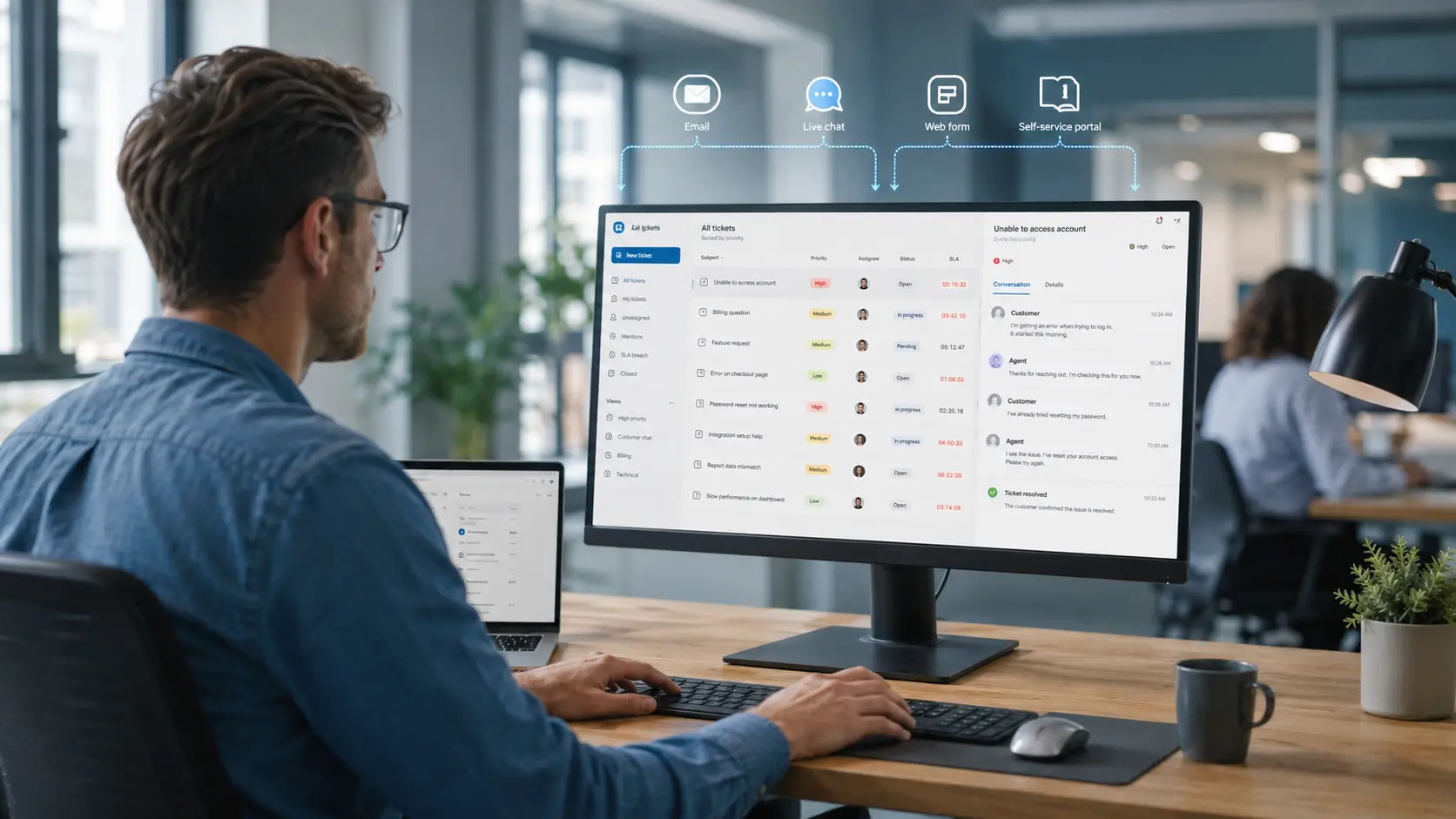

The terms sound interchangeable, but they are not. A help desk fixes problems; a service desk manages IT services more broadly. Knowing the difference helps you choose the right approach for your team.
This guide explains what each one is, how they differ, and which your organization actually needs. It also shows how both fit within IT service management.
If you only read one section, read this. A help desk is focused on fixing user issues, while a service desk is the single point of contact for all IT services.
Put simply, a help desk is reactive and support-focused. A service desk is broader, aligned with ITSM, and handles both incidents and service requests.
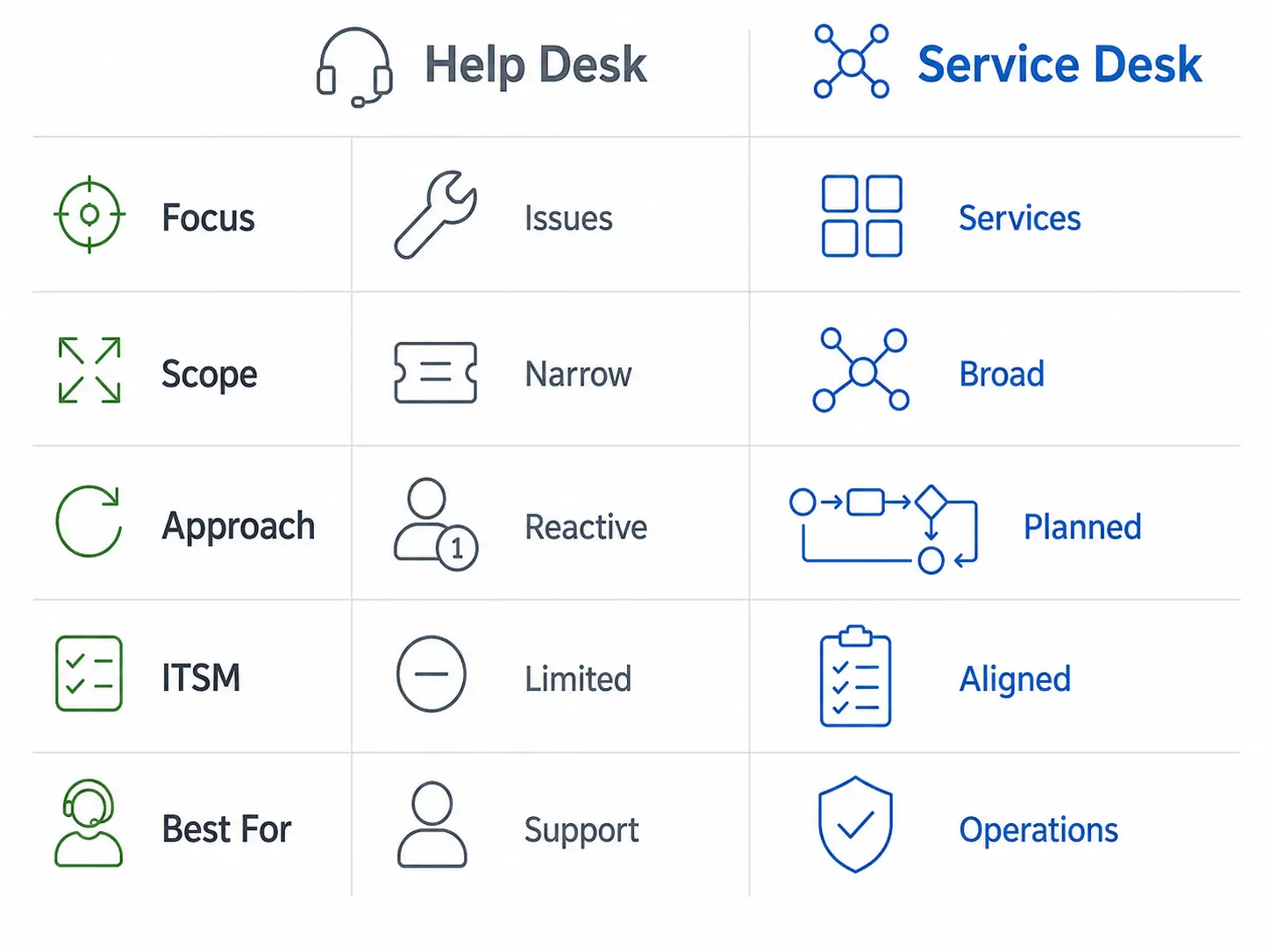
The table below sums up the differences before we dig in.
| Factor | Help desk | Service desk |
|---|---|---|
| Focus | Fixing issues | Managing IT services |
| Scope | Break-fix support | Incidents plus service requests |
| Approach | Reactive | Proactive and strategic |
| ITSM alignment | Limited | Built around ITSM |
| Best for | Simple support needs | Full service management |
Focus
Scope
Approach
ITSM alignment
Best for
A help desk is a support function that helps users solve problems. It answers questions and fixes issues, usually one ticket at a time.
Its focus is reactive. Something breaks or a user has a question, and the help desk responds.
For many small teams, a help desk is enough. It handles the day-to-day support that keeps people working.
A service desk is the single point of contact between IT and its users. It manages the full range of IT services, not just fixes.
It handles incidents and service requests alike. It also connects to wider ITSM processes such as change and problem management.
The service desk is more strategic. It is built to deliver and improve services, not only to react to issues.
Beyond the definitions, a few practical differences shape which you need.
A help desk mostly handles break-fix support. A service desk handles that plus service requests, and links to change, problem, and asset management.
A help desk waits for issues and responds. A service desk also works proactively, using data and processes to prevent issues and improve services.
A help desk is a support tool. A service desk is part of a service management strategy, aligned with frameworks like ITIL.
The right choice depends on your goals and maturity. A few questions make it clear.
If you mainly need to answer questions and fix issues for a small team, a help desk may be enough. It is simpler and quicker to run.
If you want to manage IT as a set of services, with SLAs, requests, and structured processes, a service desk fits better. It scales with a growing, more complex organization.
Many teams start with a help desk and grow into a service desk. The good news is that one modern platform can do both.
The service desk is a central part of IT service management. It is the front door through which incidents and requests enter the ITSM processes.
A help desk can operate without a full ITSM approach. A service desk, by contrast, is designed to work within one.
This is why the choice is really about ambition. A service desk signals that IT is managed as a strategic set of services, not just a fix-it team.
“The Complete Guide to IT Service Management (ITSM).“
A help desk can quietly outgrow its role. A few signals show when to step up.
Watch for rising ticket volume and slipping response times. When a simple inbox can no longer keep pace, structure helps.
Watch for more than break-fix work too. Once you handle service requests, approvals, and multiple teams, a service desk fits better.
The move does not have to be disruptive. A platform that does both lets you add structure without switching systems.
Hengine SDP is a smart digital platform for service management, so it goes beyond basic help desk support. Its ServiceHub engine handles incidents and service requests through a full ticket lifecycle.
SLA management, workflow automation, and role-based access bring the structure a service desk needs. Vital Analytics and a real-time dashboard add the visibility to manage and improve services.
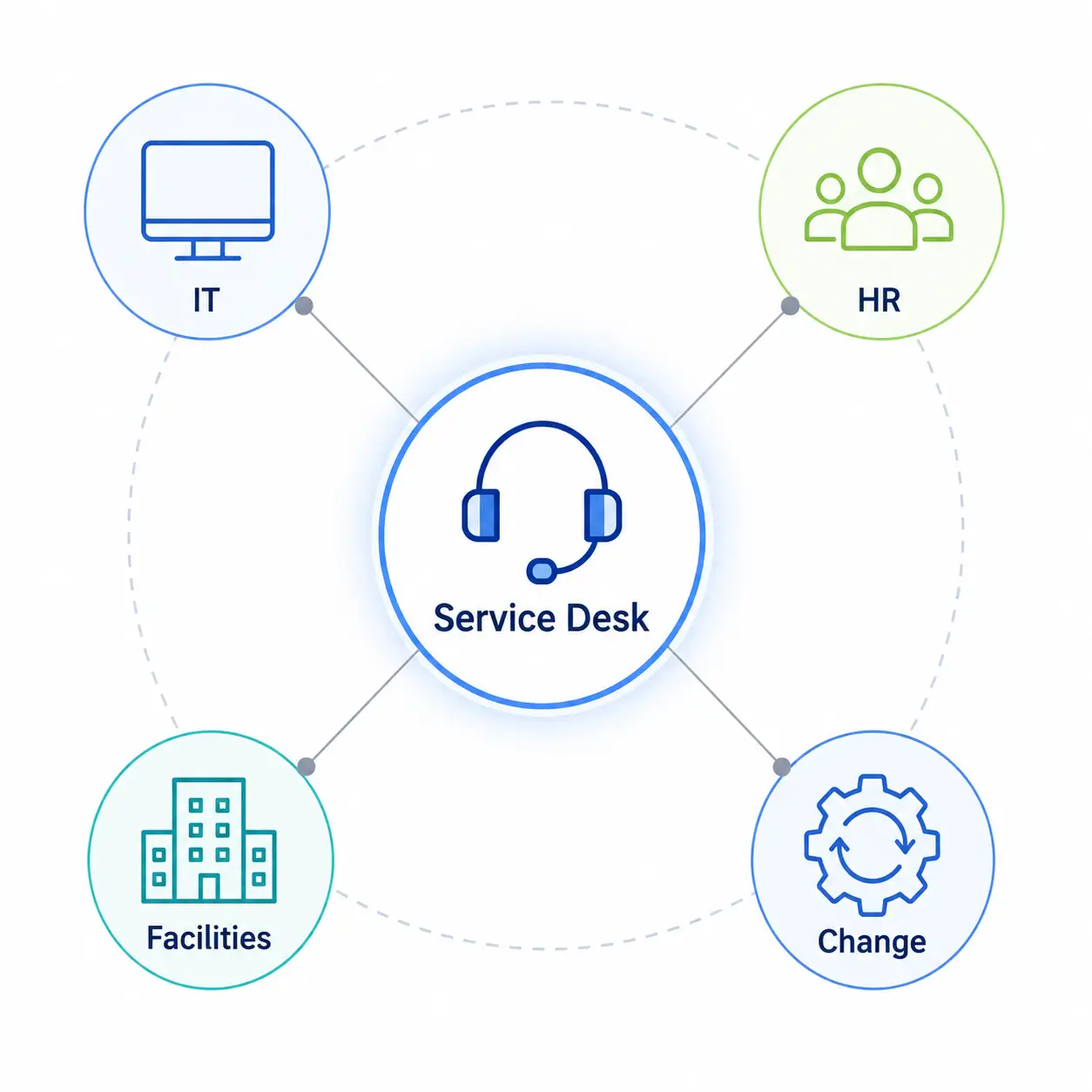
Because it serves customer and internal requests alike, it works as a service desk for IT, HR, and facilities together. Teams can start simple and add structure as they mature.
See also: One Helpdesk for IT, HR & Facilities Requests.
Next step: Run a modern service desk with SLAs, automation, and analytics in one platform. Book a Hengine demo or start with the free Fremium plan.
No. A help desk focuses on fixing user issues. A service desk is the single point of contact for all IT services, handling both incidents and service requests. It is broader and aligned with ITSM.
Neither is universally better. A help desk suits small teams with simple support needs. A service desk suits organizations that want to manage IT as a set of services with SLAs and structured processes.
Yes. Modern platforms can run as a simple help desk or a full service desk, depending on how you configure them. This lets a team start small and expand into service management as it grows.
No. A service desk aligns naturally with ITIL, but you do not need ITIL certification to run one. You can apply service desk principles, add SLAs and processes, and explore frameworks as you mature.