
Buyers often ask one question during evaluation: is this tool ITIL certified? It is a fair question, but the honest answer needs a little context.
Hengine is ITIL-aligned. It supports many ITIL practices, but no software can be ITIL certified. This guide explains why, and maps Hengine to the ITIL practices in detail.
It is written to be provable. If a buyer asks you to back up the claim, this is the evidence.
No. ITIL certification applies to people, not products. Individuals earn ITIL certificates; tools do not.
There is no official scheme that certifies software as ITIL compliant. Any vendor claiming to be ITIL certified is using the term loosely.
The only accurate claim for a product is ITIL-aligned. That means the tool supports ITIL practices, without implying an official stamp that does not exist.
ITIL-aligned means Hengine’s features map to recognized ITIL practices. It follows the principles, structure, and workflows ITIL describes.
It does not mean Hengine covers every ITIL practice. Some are fully supported, some partially, and some fall outside its scope.What Is ITIL guide
The table below is honest about all three. That honesty is what makes the claim defensible.
This maps Hengine against ITIL management practices, grouped by how fully it supports each one.
| Coverage | ITIL practice | Notes |
|---|---|---|
| Full | Service desk | Central intake and agent workspace |
| Full | Incident management | Logging, routing, resolution, SLAs |
| Full | Service request management | Request intake and fulfillment workflows |
| Full | Service level management | Separate response/resolution targets, priority and department variation, pause/resume, auto-escalation, compliance reporting |
| Full | Continual improvement | Metrics and reporting to drive change |
| Full | Workforce and talent management | Roles, assignment, and workload distribution |
| Full | Information security management | Access controls and secure handling |
| Full | Measurement and reporting | Dashboards and analytics |
| Partial | Change enablement | Workflow, approvals, audit trail; no change calendar or CAB |
| Partial | Problem management | Trend visibility; no distinct problem record |
| Partial | Monitoring and event management | Service-level monitoring, not infrastructure |
| Partial | Relationship management | Basic support; not a full CRM |
| Out of scope | Service configuration (CMDB) | Not provided |
| Out of scope | IT asset management | Not provided |
| Out of scope | Release and deployment | Not provided |
| Out of scope | Infrastructure and capacity | Not provided |
| Out of scope | Knowledge management | Not a core module |
Full
Full
Full
Full
Full
Full
Full
Full
Partial
Partial
Partial
Partial
Out of scope
Out of scope
Out of scope
Out of scope
Out of scope
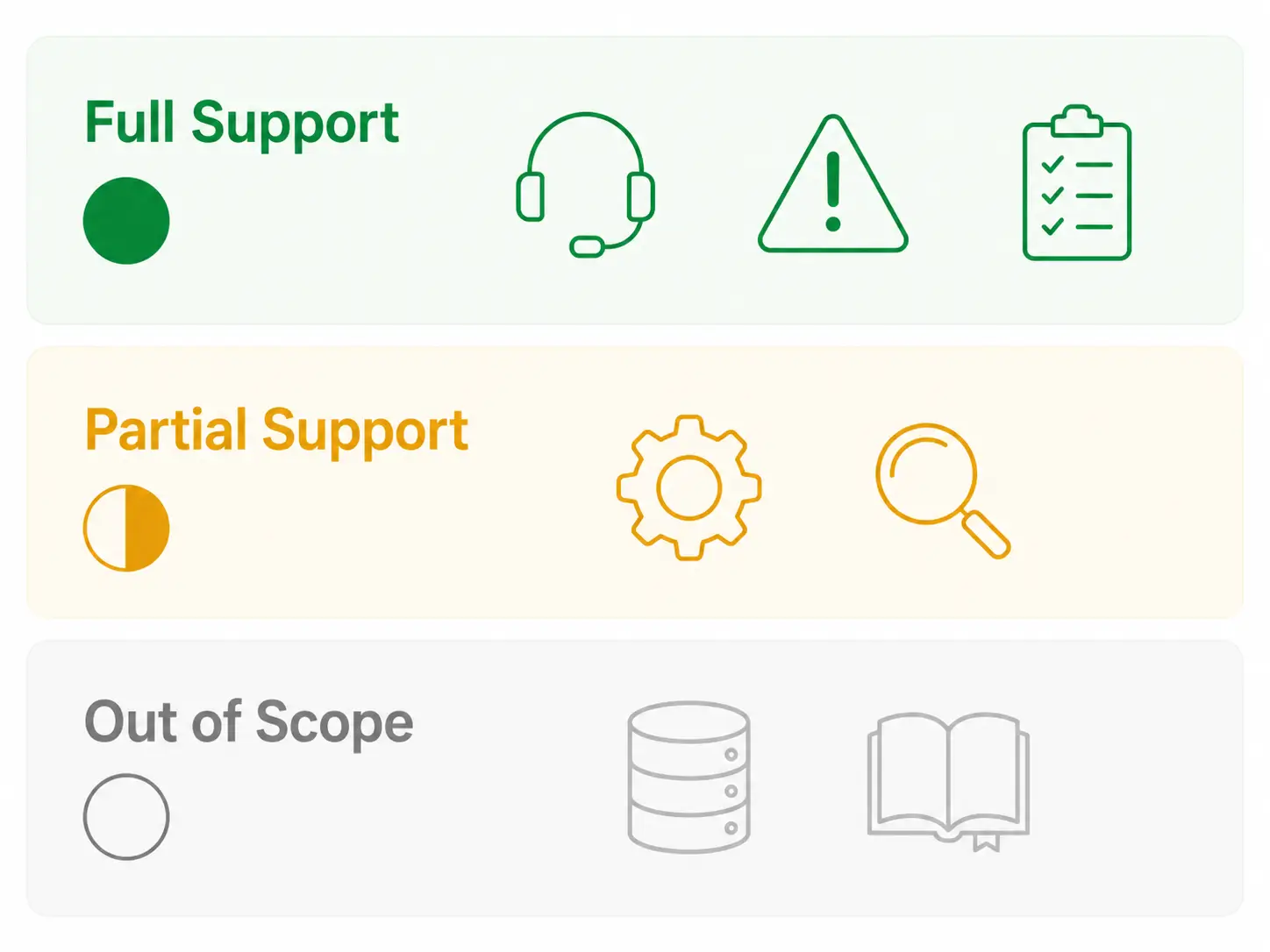
Hengine covers eight ITIL practices in full. These are the core of day-to-day service management.
The standout is service level management. Hengine handles separate response and resolution targets, variation by priority and department, pause and resume, auto-escalation, and compliance reporting. SLA management guide
Incident management, service request management, and the service desk form the operational base. Continual improvement, measurement, and reporting close the loop. incident management guide
Four practices are supported in part. It is important to be clear about the limits.
Change enablement includes workflows, approvals, and an audit trail. It does not include a change calendar or a formal change advisory board.
Problem management offers trend visibility, but not a distinct problem record separate from incidents. Monitoring works at the service level, not infrastructure. Relationship management is basic, not a full CRM. problem management guide
Some ITIL practices fall outside Hengine’s design. Naming them openly builds trust with technical buyers.
Hengine does not provide a CMDB, IT asset management, release and deployment, or infrastructure capacity management. Knowledge management is not a core module.
Teams needing these often pair Hengine with dedicated tools through integrations.

Match Hengine’s coverage to your real needs. Most teams use a handful of practices heavily, not all 34.
If your priorities are the service desk, incidents, requests, and SLAs, Hengine aligns well. If you need full CMDB or asset management, plan to integrate other tools.
Ask any vendor to show, not just claim, ITIL alignment. This mapping is Hengine’s answer to that request.
ITIL Version 5 launched in February 2026. It runs in parallel with ITIL 4 and retains all 34 practices, with a few recategorized.
Because the practices carry forward, Hengine’s alignment does not change under ITIL v5. The mapping above holds for both versions. What Is ITIL guide
No software can be ITIL certified, because ITIL certifies people, not products. Hengine is ITIL-aligned, meaning it supports recognized ITIL practices.
Eight, including the service desk, incident management, service request management, and service level management. SLA management is especially deep.
It does not provide a CMDB, IT asset management, release and deployment, infrastructure capacity, or a core knowledge base. Integrations can fill these gaps.
No. ITIL v5 keeps all 34 practices, so the mapping still applies. Hengine remains ITIL-aligned under both ITIL 4 and v5.
Most teams do not. Focus on the practices you use daily, and match a tool to those rather than to a full checklist.
Hengine aligns with the ITIL practices most teams rely on every day, with SLA management as a particular strength. It is honest about what it does not cover.
To see how Hengine supports ITIL-aligned service management, book a demo or start with the free plan.
Disclaimer: ITIL is a registered trademark of PeopleCert. Hengine is not affiliated with or endorsed by PeopleCert. “ITIL-aligned” describes feature support, not official certification. Coverage is accurate as of September 2026 and based on Hengine feature documentation; confirm current capabilities before purchase.