

In most support teams, work is not shared evenly. A few agents handle the bulk while others wait for tickets.
This imbalance slows responses and wears people down. It also hides your true capacity.
This guide explains how to balance ticket workload, the main distribution methods, and how automation keeps work fair as you grow.
Imbalance is rarely intentional. It builds up from small, everyday habits.
Fast agents grab easy tickets first. Hard tickets pile up and get passed around. New agents get too little or too much.
Without a clear system, the busiest people stay busiest. That is a recipe for burnout and missed SLAs.
Balanced does not mean identical. It means fair and sustainable, given skills and ticket difficulty.
Each agent has a steady, manageable queue. Urgent tickets reach someone quickly. No ticket sits unassigned for long.
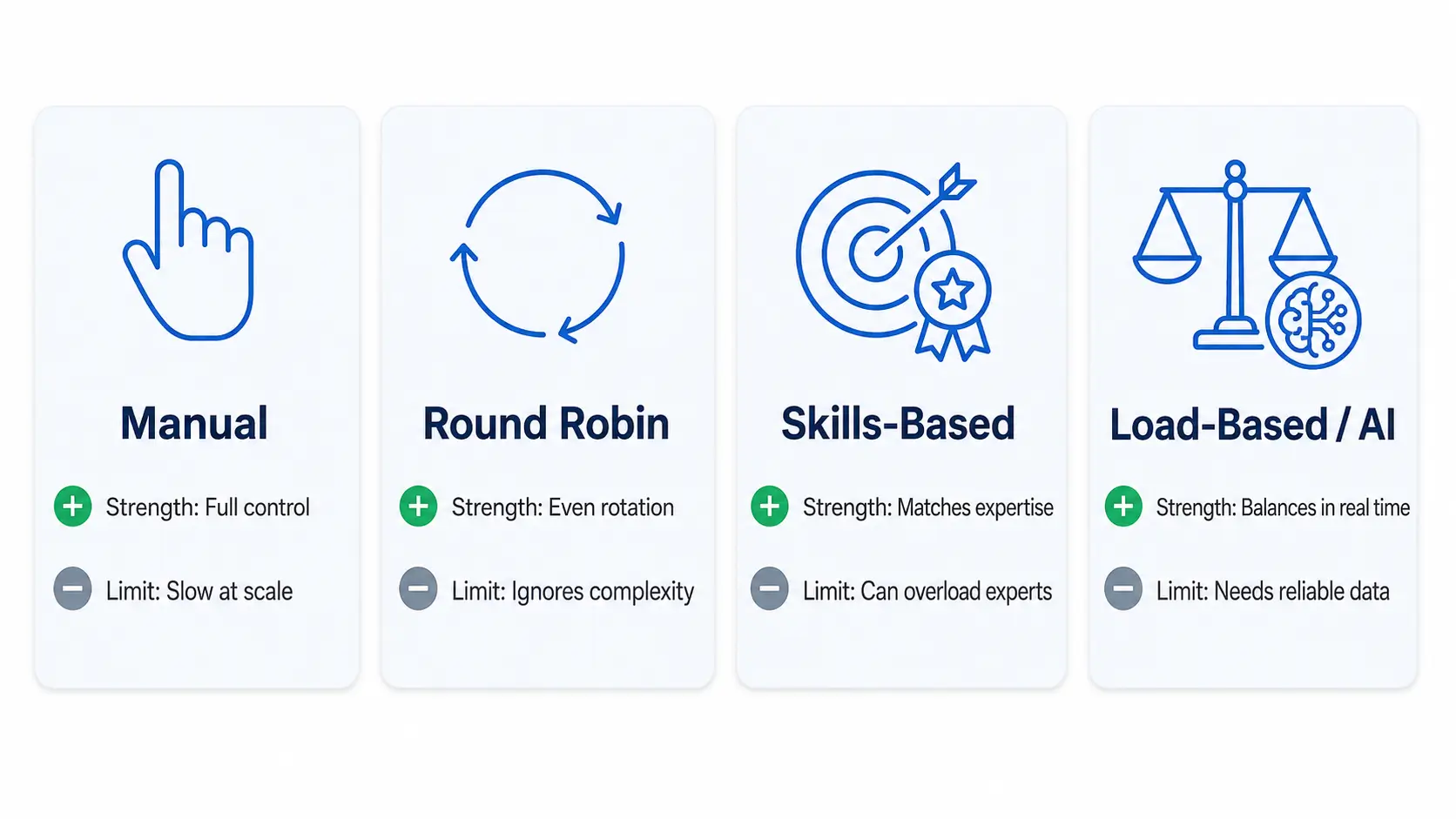
The method you choose shapes fairness and speed. Here are the main options.
| Method | How it works | Strength | Limit |
|---|---|---|---|
| Manual | A lead assigns each ticket | Full control | Does not scale |
| Round robin | Tickets rotate evenly | Simple and even | Ignores skill and load |
| Skills-based | Routes by expertise | Right agent, faster fix | Can overload specialists |
| Load-based / AI | Routes by skill and current load | Balanced and adaptive | Needs the right tool |
Manual works for tiny teams. A lead sees each ticket and assigns it by judgment.
It breaks down fast as volume grows. The lead becomes a bottleneck.
Round robin spreads tickets evenly in turn. It is simple and feels fair.
But it ignores skills and current load. A slow, complex ticket counts the same as an easy one.
Skills-based routing sends tickets to agents with the right expertise. Customers get faster, better answers.
The risk is overloading your specialists. Pair it with load awareness to avoid that.
Load-based routing weighs current workload, not just skills. AI routing combines skill, priority, and load in real time.
This keeps queues balanced automatically as conditions change. AI ticket routing guide
You can improve balance without new tools first. Then automate to hold the gains.
Work-in-progress limits are powerful. They stop any agent from hoarding or drowning in tickets.
Track these to know whether balance is improving.
Compare across agents, not just totals. A healthy team shows similar load, not wide gaps.
Manual balancing takes constant attention. Automation does it continuously.
AI routing assigns each ticket by skill, priority, and current load. It reacts instantly when a queue spikes.
Hengine uses AI routing to spread work fairly, so no agent is buried while others idle.
Real-time dashboards show load at a glance, so leads can step in early. analytics and reporting guide
Balance is harder when tickets arrive from many channels and time zones. Email, chat, and forms all feed the same team.
Route every channel into one queue so nothing is missed. A single view prevents one channel from being neglected.
For teams across time zones, hand off open work clearly at shift changes. A short handoff note keeps momentum and avoids duplicate effort.
Adjust routing rules by shift if volume patterns differ. Mornings and evenings often need different coverage.

Equal ticket counts can still be unfair. One complex case may take longer than five simple ones.
Weight distribution by effort, not just count. Load-based routing does this by tracking real workload, not ticket numbers alone.
When agents trust the system is fair, they focus on customers instead of the queue.
For growing teams, load-based or AI routing works best. It balances skill, priority, and current workload automatically.
Round robin is simple and even, but it ignores skills and load. It suits small teams with similar ticket types.
Set work-in-progress limits and use load-aware routing. Both prevent any one agent from holding too many tickets.
Automate once manual assignment slows you down or misses tickets. Most teams reach this point as volume grows.
Start by measuring load per agent and setting priorities. Then pick a distribution method and add limits.
To see AI routing that balances workload in real time, explore how Hengine distributes tickets.