
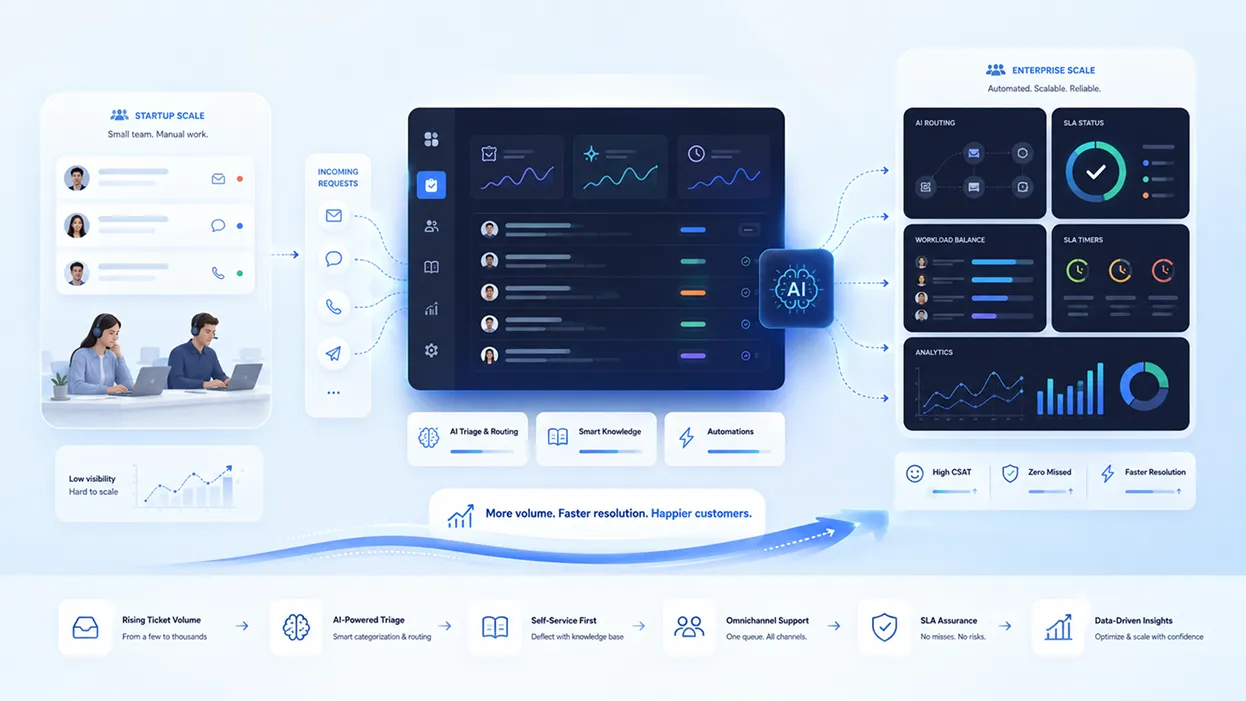
Early on, support is simple. A founder or a small team answers every message personally, and customers feel the care.
Then growth arrives. Ticket volume climbs faster than headcount, response times slip, and the personal touch starts to fray.
The goal of scaling support is to handle far more requests without hiring at the same pace. This guide covers what scaling means, when to do it, and the strategies that work, and it pairs well with our guide to the best helpdesk for startups.
Scaling customer support from startup to enterprise with AI ticket routing, SLA tracking, and workload automation.
Scaling support means increasing the volume of requests your team can handle while maintaining quality and speed. It is about capacity, not just adding people.
A well-known target captures the idea: handle ten times the tickets without ten times the headcount. You reach it by removing repetitive work, not by burning out agents.
Done well, scaling lets a lean team support a large customer base with consistent service.
Support quality shapes retention. When response times stretch and answers grow inconsistent, customers notice, and churn rises.
Scaling protects the experience as you grow. It keeps first responses fast and answers accurate even as volume multiplies.
It also protects the team. Agents who are not buried in repetitive tickets have time for the complex problems that actually need a human.
Most teams feel the strain before they name it. A few signals make the timing clear.
Any two of these together usually mean your current process has reached its ceiling.
Scaling is the sum of several changes, each removing a slice of manual work. The strategies below build on one another.
A searchable knowledge base lets customers solve common issues themselves. Every answered question that never becomes a ticket is capacity you get back.
For example, a clear billing help article can quietly absorb a large share of routine how-to questions.
AI does not have to replace agents to help them. Suggested replies and automatic ticket summaries cut the time spent on each request.
Agents stay in control and approve the response, while the routine typing shrinks.
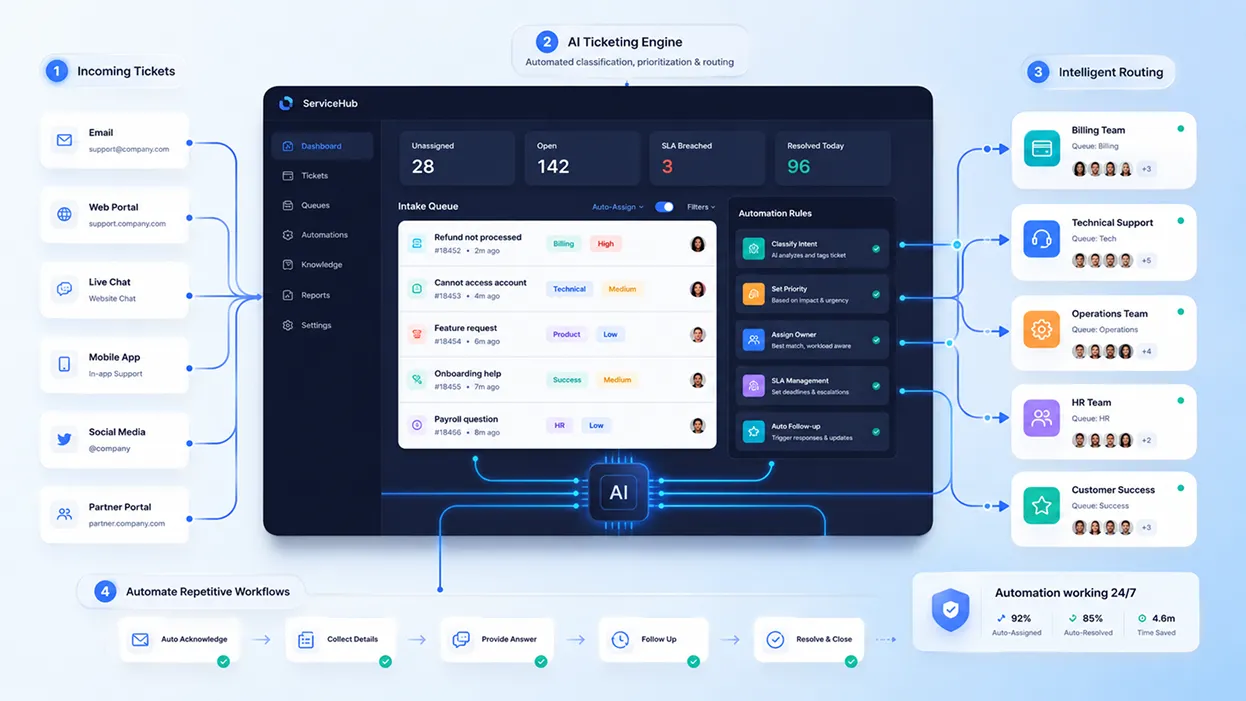
Automated ticket routing assigns support requests to the right teams without manual sorting.
Manual sorting is a hidden tax on every ticket. Automated routing reads each request and instantly assigns it to the right person or team.
Rules can also tag, prioritize, and trigger follow-ups, so agents spend their time resolving rather than organizing. If you are new to building these rules, start with ticket automation without code.
Customers reach out by email, chat, and portal. Bringing those channels into one queue prevents duplicate work and missed messages.
A single queue also means a request is handled once, no matter where it started.
A knowledge base is the foundation of self-service. As it grows, it answers more questions before they ever reach an agent.
Treat every repeat ticket as a signal. If a question comes up often, write an article once and link to it, so the answer scales without extra effort.
You cannot scale what you cannot see. Watch first response time, resolution time, SLA compliance, and customer satisfaction.
These numbers show where the process strains next, so you fix the real bottleneck instead of guessing.
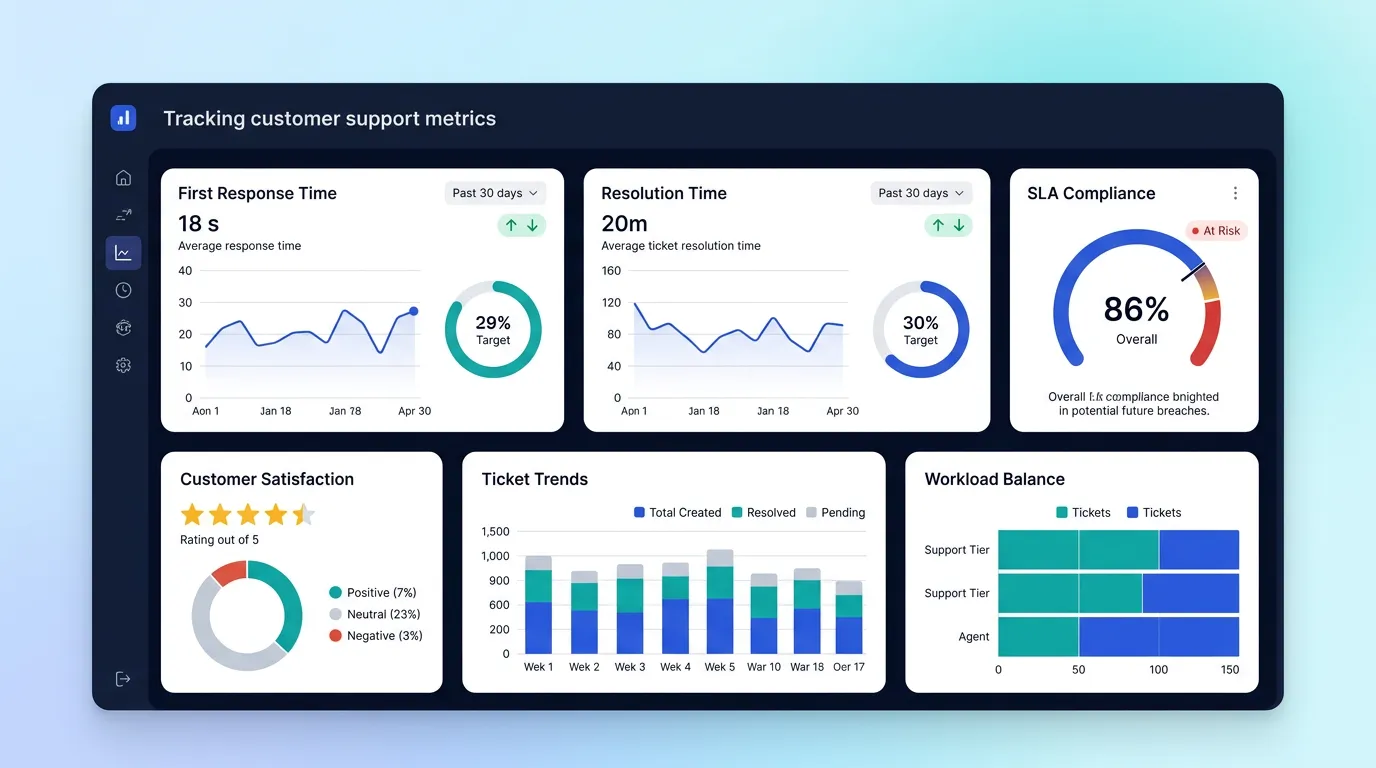
Support analytics dashboard tracking first response time, resolution time, SLA compliance, and customer satisfaction.
Process changes pair with how you organize people. As volume grows, a tiered structure keeps the right work with the right person.
Tier 1 handles common requests with help from automation and self-service. Tier 2 takes the complex cases that need deeper expertise.
This way, new hires ramp on routine tickets while experienced agents focus on hard problems. You add headcount deliberately rather than reactively.
Scaling goes wrong in predictable ways. Knowing them helps you avoid the usual setbacks.
The pattern is consistent. Fix the process first, then let automation and headcount multiply a system that already works.
Hengine SDP is designed to grow with a team. Its ServiceHub ticketing engine and Workflow Automation auto-assign tickets by rule, so routing keeps pace as volume rises.
Vital Analytics tracks SLA compliance, ticket trends, and technician performance, and flags workload imbalance before it becomes a backlog. Teams and Workload Management then help distribute work evenly as the team grows, so you can start small and scale to enterprise without rebuilding your stack.
Next step: Hengine helps you start small and scale to enterprise without rebuilding your stack. Book a demo or start a free trial to see automated routing and workload insights in action.
How do you scale support without hiring more agents?
You remove repetitive work. Self-service deflects common questions, automation handles routing and tagging, and AI assists with replies. This lets the same team handle far more tickets before new hires are needed.
When should a startup start scaling its support?
Watch for rising response times, repeated questions, and frequent misrouting. When these appear together, your current process has hit its limit, and it is time to add automation and structure.
What metrics matter most when scaling support?
First response time, resolution time, SLA compliance, and customer satisfaction. Together, they show whether quality is holding as volume grows, and where the next bottleneck is forming.