

Staffing a support team is a balancing act. Too few agents and service suffers; too many and costs climb.
Get it right and you keep customers happy, agents healthy, and budgets sane.
This guide explains how to plan customer service staffing, model coverage, and adjust as demand shifts.
Staffing is deciding how many agents you need, with what skills, and when. It connects forecasting to real schedules.
It builds on capacity planning, which estimates the total agents required. Staffing turns that number into coverage.
Demand is uneven, and people are not interchangeable. Several factors make staffing tricky.
Ticket volume rises and falls by hour, day, and season. A flat schedule rarely matches a bumpy demand curve.
Not every agent handles every issue. Coverage must include the right skills, not just enough bodies.
Support roles see high turnover, so plans must assume some churn. Staffing to the bare minimum leaves no cushion.
A clear process keeps staffing grounded in data, not guesswork.
Match start times to when tickets actually arrive. Coverage that peaks at the wrong hour wastes effort.
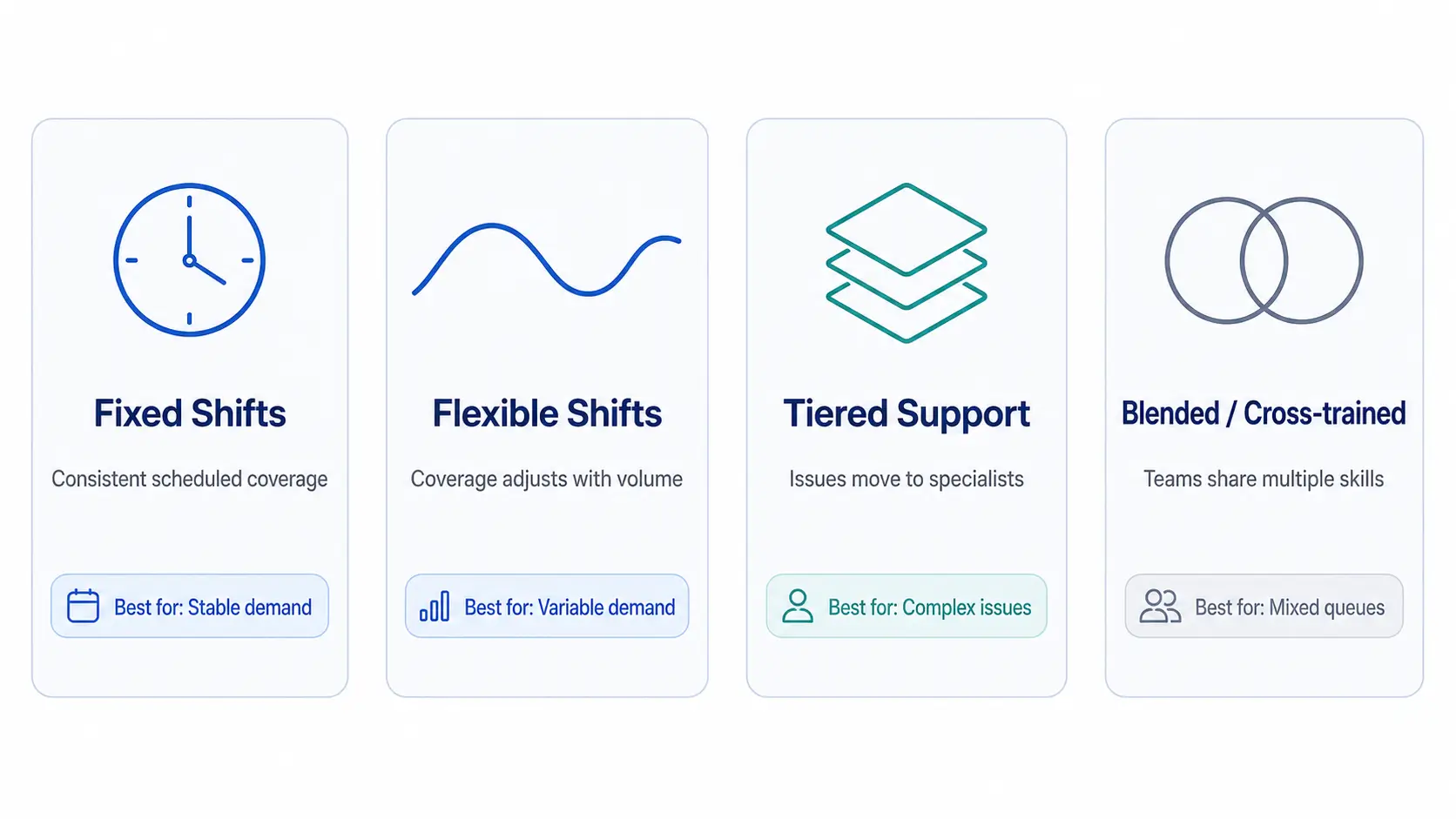
Different models suit different teams. Many use a mix.
| Model | How it works | Best for |
|---|---|---|
| Fixed shifts | Set schedules each week | Stable, predictable demand |
| Flexible shifts | Start times shift with demand | Variable daily peaks |
| Tiered support | Frontline plus specialists | Mixed issue complexity |
| Blended / cross-trained | Agents cover multiple queues | Teams needing flexibility |
Fixed shifts
Flexible shifts
Tiered support
Blended / cross-trained
Cross-training adds flexibility. When one queue spikes, trained agents can move to help.
Peaks need extra coverage; quiet periods need less. Plan for both to avoid waste.
For predictable spikes, schedule more agents in advance. For seasonal surges, consider temporary or cross-trained staff.
In quiet periods, shift agents to training or backlog. This uses idle time well without adding cost.
These metrics show whether your staffing is working.
If SLAs slip at the same hour each day, your coverage is misaligned.

Good routing makes each agent go further. That lowers how many you need on shift.
AI routing balances load in real time, smoothing the peaks a schedule cannot fully predict.
Hengine’s analytics reveal demand patterns, so you can staff shifts with confidence.
Staffing is also about where your agents come from. Each model has trade-offs.
In-house teams give the most control over quality and brand voice. They cost more and take longer to scale.
Outsourced teams scale quickly and cover odd hours. The trade-off is less direct control and a learning curve on your product.
Many teams blend the two. Core issues stay in-house, while overflow or after-hours volume goes to an outsourced partner.
Whatever the mix, hold every group to the same SLAs and quality standards. Consistency matters more than location.
New agents are not productive on day one. Ramp time affects how soon a hire adds real capacity.
Factor ramp time into staffing plans. If it takes weeks to get productive, hire ahead of the demand you expect.
Strong onboarding and clear knowledge resources shorten ramp time. That turns new hires into contributors faster.
Base it on forecasted demand and a realistic per-agent rate, plus a buffer. Capacity planning gives the starting number.
Forecast peaks, schedule extra coverage in advance, and cross-train agents. Temporary staff can cover large seasonal surges.
Most teams blend fixed and flexible shifts with cross-training. The right mix depends on how variable your demand is.
Better routing balances load, so each agent handles more without strain. This can lower the headcount a shift needs.
Forecast demand, plan coverage with the right skills, and adjust as you learn. Add a buffer for turnover and spikes.
To see demand patterns and balance load in real time, explore how Hengine supports staffing decisions.