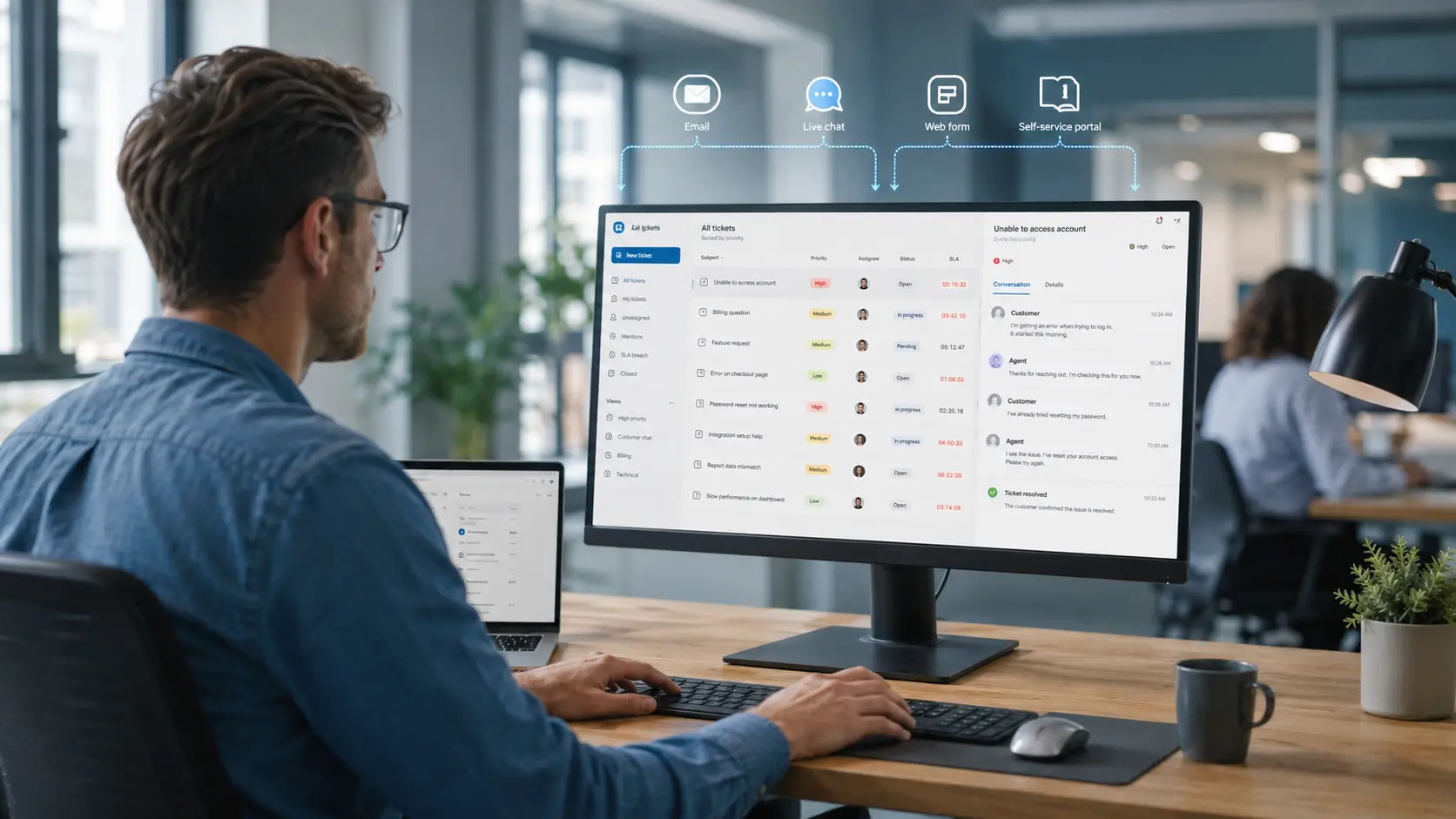
The short answer is who does the work. A traditional helpdesk relies on agents to sort and route every ticket, while an AI helpdesk automates that sorting and assists with replies.
This article compares the two side by side. It helps you decide which fits your team, and when moving to an AI helpdesk is worth it.
If you only read one section, read this table. It summarizes the practical differences.
This comparison describes general capabilities, not benchmark figures. Real results depend on your tools, volume, and setup.
| Factor | Traditional helpdesk | AI helpdesk |
|---|---|---|
| Ticket sorting | Manual, by agents | Automatic, by intent |
| First response | Slower at high volume | Faster and consistent |
| Repetitive questions | Answered one by one | Deflected by self-service |
| Routing accuracy | Depends on the agent | Learns from past tickets |
| Scaling | Needs more headcount | Absorbs spikes with automation |
| Reporting | Backward-looking | Predictive and trend-aware |
Ticket sorting
First response
Repetitive questions
Routing accuracy
Scaling
Reporting
The rest of this guide explains each row and when it matters.
A traditional helpdesk is a system that stores and tracks support tickets. Agents read each request, decide its priority, and route it by hand.
It does its job well at low volume. A small team can comfortably sort a handful of tickets a day without help.
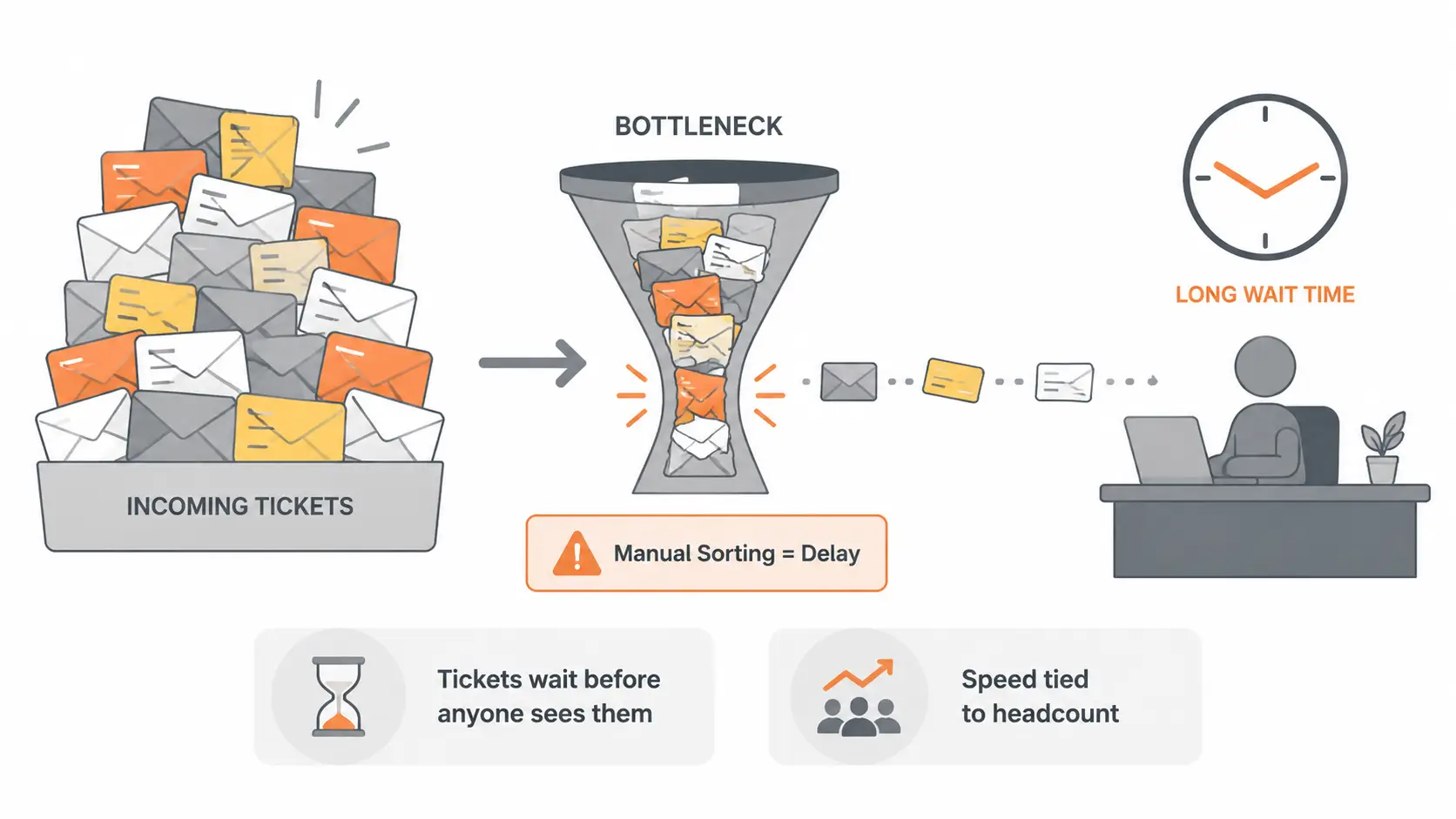
The limits show as volume grows. Manual sorting becomes a bottleneck, and tickets wait longer just to reach the right person.
An AI helpdesk adds automation and machine learning to the same core. It reads tickets, categorizes them, routes them, and can suggest or send replies.
The difference is judgment at scale. The system applies consistent logic to every ticket, no matter how busy the queue gets.
It does not remove people. Agents still handle complex cases, but they are freed from repetitive sorting and routine answers.
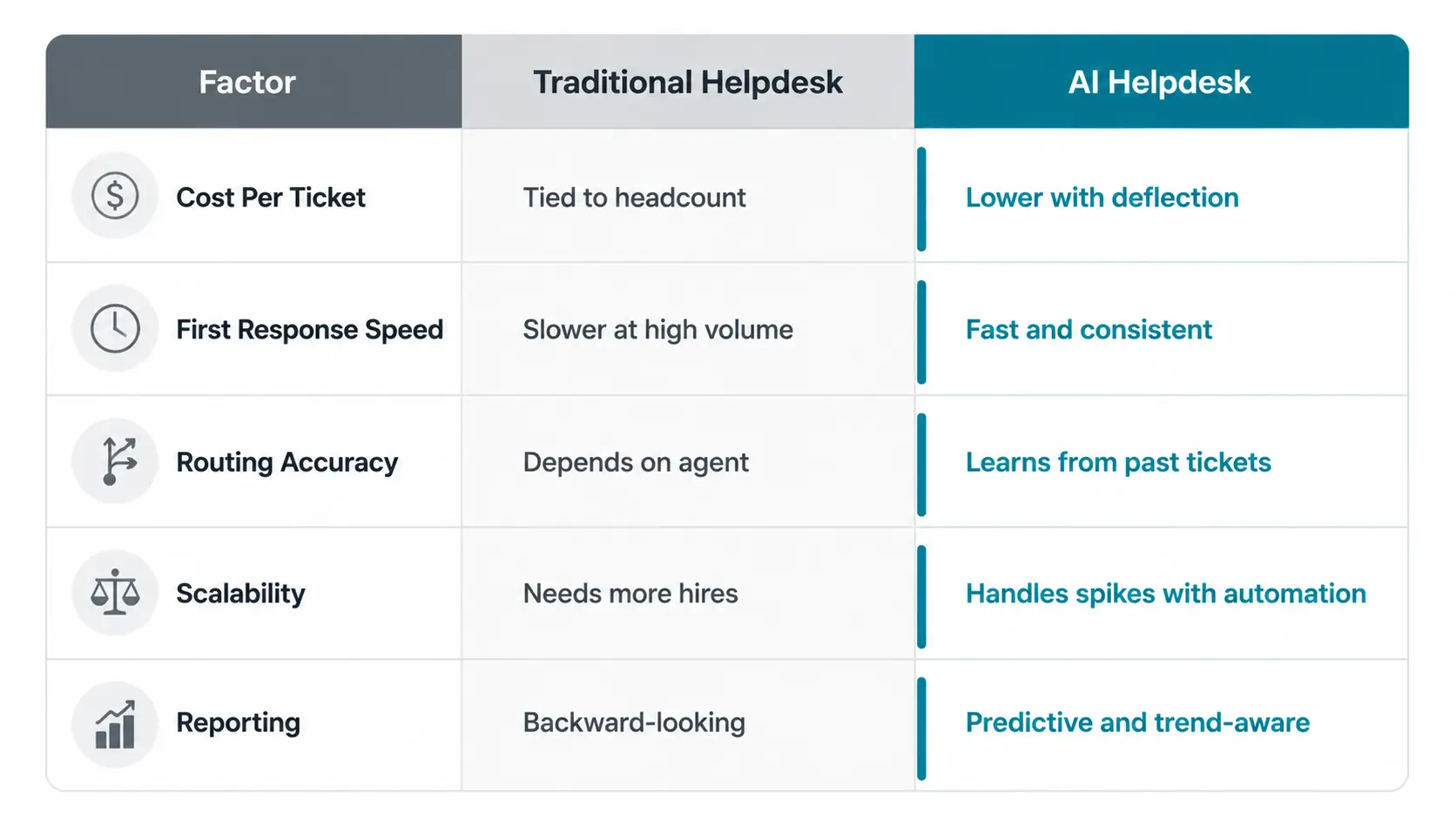
A closer look at the key factors shows why teams switch.
Traditional helpdesks tie cost to headcount, since people do the work. AI helpdesks lower cost per ticket by deflecting routine requests and speeding up the rest.
Manual triage adds delay before an agent even sees a ticket. Automatic routing removes that gap, so first responses are faster and more predictable.
People make sorting mistakes, especially when rushed. AI routing learns from past tickets, which reduces the misroutes that cause slow resolutions.
A traditional helpdesk only moves as fast as its staff. An AI helpdesk handles volume spikes with self-service and automation, without emergency hiring.
In a traditional setup, agents carry the full load of triage and replies. In an AI setup, automation absorbs the routine, so agents focus on harder problems.
AI is not always necessary. For a very small team with low, predictable volume, a traditional helpdesk can be simpler and cheaper.
If your requests are few and varied, manual handling may be fine. The overhead of setting up automation may not pay off yet.
The picture changes as you grow. Once sorting and repetitive questions eat real hours, the case for an AI helpdesk becomes clear.
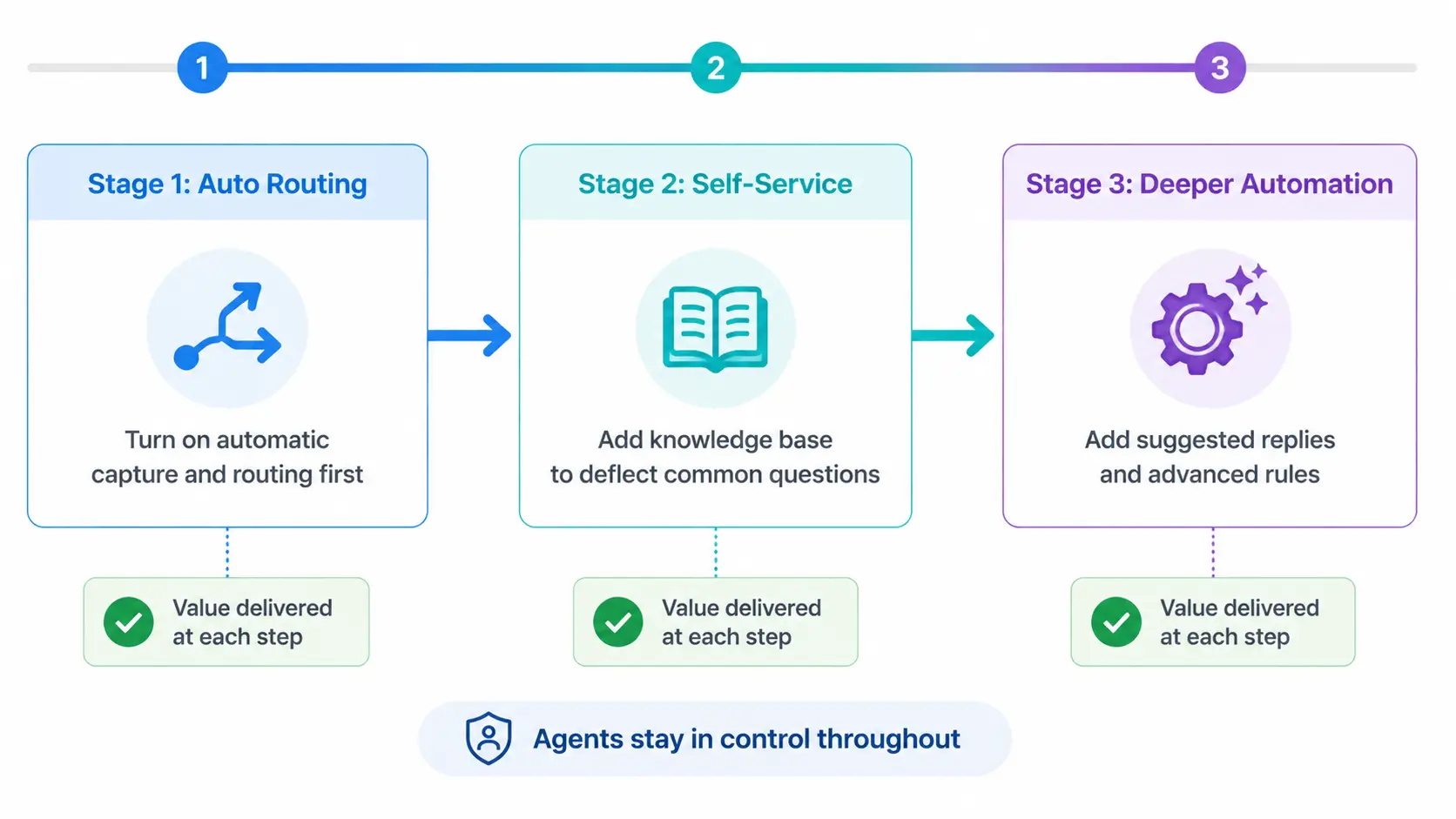
Switching does not have to be risky. A staged approach keeps service steady.
Start by turning on automatic capture and routing, which delivers value fast. Then add self-service articles to deflect common questions.
Finally, introduce suggested replies and deeper automation. Keep agents in the loop throughout, so they trust the system before it handles more.
A few myths make teams hesitate longer than they need to. It helps to clear them up.
One myth is that AI replaces agents entirely. In reality, it handles routine sorting and replies, while people keep the complex and sensitive work.
Another is that AI helpdesks are only for large companies. Many tools offer free or low-cost tiers, so small teams can start with the basics today.
A third is that setup takes months. Most teams go live with automatic routing quickly, then add features in stages rather than all at once.
A final myth is that automation feels impersonal. Used well, it actually frees agents to spend more time on the conversations that need a human touch.
Hengine SDP gives you traditional structure with an intelligent layer on top. Its ServiceHub engine manages the full ticket lifecycle, while Workflow Automation handles routing and assignment.
Vital Analytics adds predictive insight, including SLA risk prediction and trend forecasting. You get the reliability of a structured helpdesk and the speed of automation in one platform.
See also: The Complete Guide to AI Ticketing Systems and What Is an AI Ticketing System.Why Hengine section.
Next step: Curious how an AI helpdesk would feel for your team? Start with Hengine’s free Freemium plan or book a demo to compare it against your current process.
Not always. For very small, low-volume teams, a traditional helpdesk can be simpler and cheaper. As volume grows, an AI helpdesk usually wins on speed, consistency, and cost per ticket.
It does not have to. A staged rollout, starting with automatic routing and then self-service, keeps service steady. Agents stay in control of replies throughout.
It can have setup costs, but it often lowers cost per ticket by deflecting routine work. The right comparison is the total cost to serve your volume, not just the license price.
Yes. Many teams keep their structure and layer automation on top, automating routing first and adding more over time. Hengine is built to support exactly this.